AI Partnership
Is an insurance broker allowed to use AI?
Fabian Wesemann
6 min
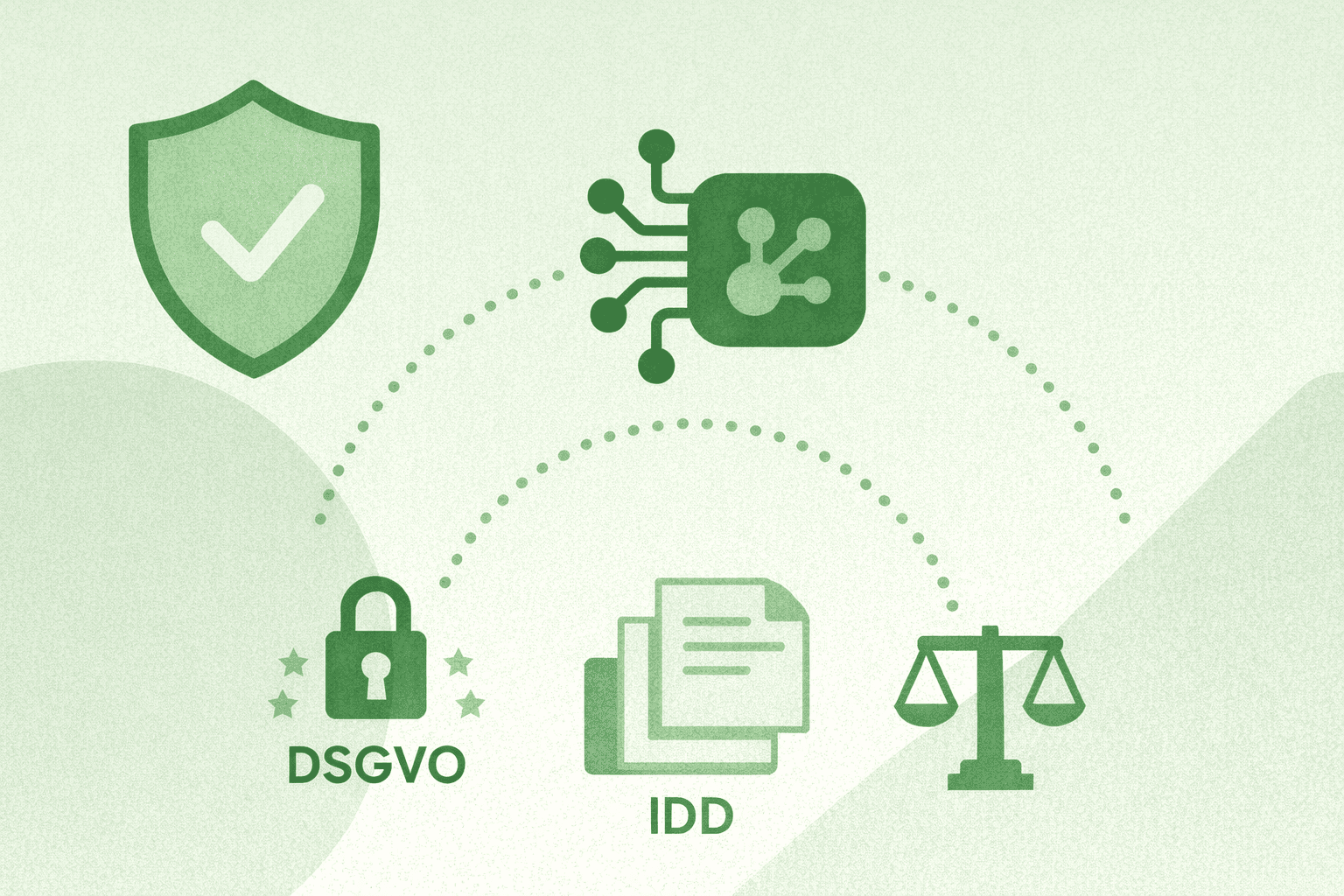
GDPR, IDD and Liability Explained in Simple Terms
Are insurance brokers allowed to use artificial intelligence, or do GDPR violations and liability risks loom?
Yes, insurance brokers are allowed to use artificial intelligence.
The use of AI is generally permitted under GDPR, IDD, and the EU AI Regulation, as long as certain conditions are met. AI may assist brokers in preparation, structuring, and analysis. However, the responsibility for advice and decisions always remains with the broker.
Many brokers in Germany are asking this question because the pressure of work in daily life is increasing while regulatory demands are becoming increasingly complex. AI promises significant relief in the brokerage office, but uncertainty remains: What is allowed, what is risky, and where are the legal limits?
This article provides a clear, practical understanding for insurance brokers. Explained in understandable terms, without legal jargon, and focusing on what is really relevant in the daily life of a broker.
AI in the Brokerage Office is Generally Allowed
Neither GDPR nor IDD nor the new EU AI Regulation prohibit the use of artificial intelligence in brokerage operations. On the contrary, the legislator assumes that digital tools, including AI, will be used.
What matters is not whether AI is used, but how. AI may assist, prepare, structure, and analyze. However, the responsibility for advice and decisions must remain with the broker.
A typical example from daily life: If an AI sorts emails, checks documents, or prepares draft responses, this is legally unproblematic. The final review and approval continues to be done by the broker.
GDPR: AI May Process Data, But Only in a Controlled Manner
The GDPR is the most important framework for the use of AI in the brokerage office. It does not prohibit AI but sets clear requirements for dealing with personal data.
For brokers, this concretely means:
Only data necessary for the respective purpose may be processed.
Customer data may not be used for foreign or unclear purposes.
The broker must know where data is processed and who has access to it.
A common misunderstanding is that the mere use of AI constitutes a violation of the GDPR. This is incorrect. What is crucial is the lack of control, lack of transparency, and lack of documentation.
The current case law even provides for relief: A mere formal violation of the GDPR does not automatically lead to damages. It only becomes relevant when a specific disadvantage arises for the customer.
No Fully Automated Decisions in Advice
A central point from the GDPR and IDD is clear:
Advice-relevant decisions must not be made fully automatically.
This concerns, among other things:
Acceptance or rejection of risks without a broker's decision.
Product recommendations without human review.
Decisions with financial or legal implications for the customer.
In practice, this is rarely a problem for brokers. Most AI applications in the brokerage environment are intentionally designed as support systems. They make suggestions, recognize connections, or prepare information. The decision is still made by the broker.
As long as this principle is adhered to, the use is legally sound.
Liability Remains with the Broker, but AI Reduces Risks
A common misconception is:
If an AI prepares something, the provider is liable.
This is not true.
Regardless of whether software, a pool, or an external service provider is used, the broker remains responsible. Just like with comparison calculators, calculation tools, or text modules.
However, this is not a disadvantage. Used correctly, AI can even reduce liability risks. It works systematically, does not forget deadlines, recognizes deviations, and ensures transparent processes. Errors that easily arise in stressful daily life are detected earlier. It remains important that the broker reviews results and can understand how they came about.
EU AI Regulation: Generally No High Risk for Brokers
The new EU AI Regulation follows a risk-based approach. The higher the risk of an application, the stricter the requirements.
Typical AI applications in the brokerage office, such as text assistance, document analysis, email sorting, or internal evaluations, generally do not fall under high-risk AI.
Nevertheless, initial obligations apply:
Clear internal rules regarding the use of AI and what it is not used for.
Conscious handling of customer data, as with any other software.
The broker remains professionally responsible and reviews results.
Afori recommends exactly what many brokers are already implementing: deciding which tools to use, which data may be input, and who bears responsibility.
Integrating AI Cleanly into Compliance
For brokers, this does not mean a major overhaul but a clean structure:
AI is part of the existing data protection and IT processes.
The use is documented.
Employees know what is allowed and what is not.
Results are checked, not blindly accepted.
Those who proceed this way operate on legally secure ground.
Caution with Public AI Tools like ChatGPT
One point is often underestimated in daily life. Many brokers initially test AI with freely available tools like ChatGPT or similar providers. There is a clear GDPR risk here. Anyone entering sensitive customer data, policy numbers, health information, damage information, or contract details into public AI services is clearly violating the GDPR. In these cases, it is neither clear where the data is processed nor what it is stored or reused for.
This is not a grey area but legally clearly problematic.
How Brokers Can Recognize a Legally Compliant AI Solution
A professional AI solution for brokers must:
Work in compliance with GDPR.
Process data within the EU.
Provide data processing agreements.
Meet clear information security standards.
Not use customer data to train foreign models.
Only under these conditions does AI reduce risks instead of creating new ones.
Classification Using the Afori Example
Afori, an AI platform specifically for insurance brokers, has been developed for this professional use. The platform is built in compliance with GDPR, operates in the EU, and is certified according to ISO 27001:2022. The AI assistant works transparently, controlled, and without impermissible reuse of customer data. Additionally, specific insurance knowledge is integrated into the AI, allowing content to be categorized correctly.
This makes Afori an example of an AI solution that relieves brokers without generating legal or data protection risks.
Conclusion
Insurance brokers are permitted to use AI.
GDPR, IDD, and EU AI Regulation set frameworks, not prohibitions.
Those who use AI as assistance, protect customer data, review decisions, and document processes operate legally secure. The actual risk does not lie in the AI itself, but in uncontrolled use without clear rules.
When used correctly, AI thus becomes not a danger but a tool that enhances quality, efficiency, and security in the daily life of brokers.